Chronic Neurological Diseases: Continue Care Between Appointments
- Nataliya Bogdanova
- May 20, 2026
- FRESH LEMONMINT, TECHTALK
- 0 Comments
Chronic neurological diseases such as multiple sclerosis, migraine, and other long-term disorders do not progress in fixed clinical intervals. Symptoms evolve gradually in patients’ everyday lives – between appointments, outside consultation rooms, and often beyond the visibility of conventional care models. Neurologists and digital health experts increasingly warn that this gap between visits has become one of the central structural weaknesses in chronic care. As healthcare systems face rising patient numbers and growing complexity, continuous digital support is emerging as a key strategy to improve adherence, detect deterioration earlier, and bring care closer to real-life disease progression. The issue has now been addressed in German publication E-Health-Com.
The Blind Spot Between Visits
According to PD Dr. med. Marc Pawlitzki, neurologist in private practice in Magdeburg and senior physician at the University Hospital Düsseldorf, one of the greatest weaknesses of current neurological care is the lack of visibility into patients’ conditions between appointments.
Patients with chronic neurological diseases are often seen only a few times per year. During the months in between, they must independently assess symptoms, monitor side effects, and manage therapies in everyday life.
The greatest blind spot in clinical practice is that we are unable to monitor patients between visits.
PD Dr. med. Marc Pawlitzki
This problem is particularly significant in neurology, where symptoms may fluctuate daily, progress slowly, or overlap with psychological and physical burdens. As a result, clinically relevant deterioration is often recognized too late.
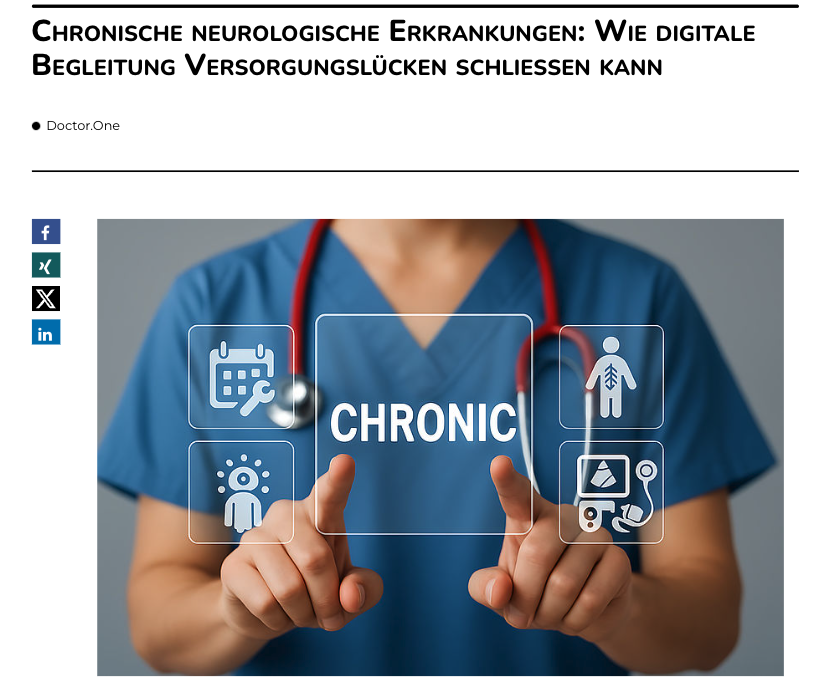
E-Health-Com is one of Germany’s most influential B2B publications for the digital transformation of healthcare. A recent report by Artur Olesch discussed how digitally enabled continuity of care can close structural gaps in chronic disease management, highlighting scientific evidence and showcasing platforms such as Doctor.One as scalable infrastructure for hybrid care models. Click here to access the full article.
Everyday Life as the Real Place of Care
Dr. Ahmad Sirfy, head of Smartpraxis Dr. Sirfy, sees the central challenge not within the healthcare system itself, but within patients’ daily lives. Between visits, medications may be taken inconsistently, warning signs overlooked, and uncertainty left unresolved.
Experts increasingly argue that chronic diseases cannot be managed effectively through episodic consultations alone. Instead, continuous communication and real-time support are becoming essential components of care.
This perspective is reinforced by a Doctor.One use-case study in multiple sclerosis care, which found that traditional care models offer limited structured support between appointments – despite the fact that these phases are critical for adherence, safety, and long-term outcomes.
The Role of Real-World Data
Pawlitzki believes neurology is shifting from a primarily diagnostic discipline toward a more therapeutic and data-driven field. This transformation increases the need for continuous real-world information about how patients function outside the clinic.
Smartphones, wearables, and digital health applications can already collect data on sleep, activity levels, heart rate, cognition, and overall well-being. Unlike isolated clinical snapshots, repeated measurements collected over time may reveal subtle deterioration far earlier.
However, experts caution that digital tools alone are insufficient. Not every signal is clinically meaningful, and data without interpretation create little value. “Data without consequences are meaningless,” Sirfy emphasizes.
Why Integration Matters
One reason many digital health concepts fail in routine practice is poor integration into clinical workflows. Pawlitzki argues that digital solutions must connect seamlessly with existing practice software and hospital systems in order to become truly useful.
Rather than fragmented disease-specific apps, experts advocate for platform-based models that allow physicians, care teams, and patients to interact through shared systems.
Digital communication platforms such as Doctor.One are designed around this principle. Their aim is to extend medical guidance into everyday life through structured, low-threshold communication between patients and healthcare professionals.
Early findings suggest this approach may improve continuity without significantly increasing workload. In Doctor.One‘s multiple sclerosis pilot, neurologists reported positive experiences with more frequent, structured patient interactions compared to standard quarterly care.
Toward Continuous Care Models
Experts increasingly agree that the future of chronic neurological care will be more continuous, personalized, and digitally supported. Technologies such as electronic patient records, connected devices, and eventually AI-supported analysis are expected to improve understanding of disease progression in real-life settings.
Importantly, digital continuity is not intended to replace in-person care. Instead, it complements clinical visits by creating ongoing support between appointments – where many of the most decisive moments in chronic disease management actually occur.
Yet sustainable implementation will require structural change. Physicians and experts argue that continuous digital communication must be recognized as a reimbursable healthcare service if it is to move beyond pilot projects and become part of standard care.
Early evidence indicates that such models can improve patient understanding, strengthen adherence, and increase care quality. For Pawlitzki and other experts, the conclusion is clear: chronic diseases unfold in everyday life – and future healthcare systems must increasingly meet patients there.