Turning Hospital Data into Better Care
- Nisha Gautam
- September 15, 2026
- TECHTALK
- Data2Value, Data2ValueExecutiveDialogue
- 0 Comments
Hospitals generate vast amounts of information across clinical care and operations. Many have invested in data warehouses and integration platforms to bring these records together. The infrastructure is increasingly sophisticated, but its direct contribution to everyday care often remains limited.
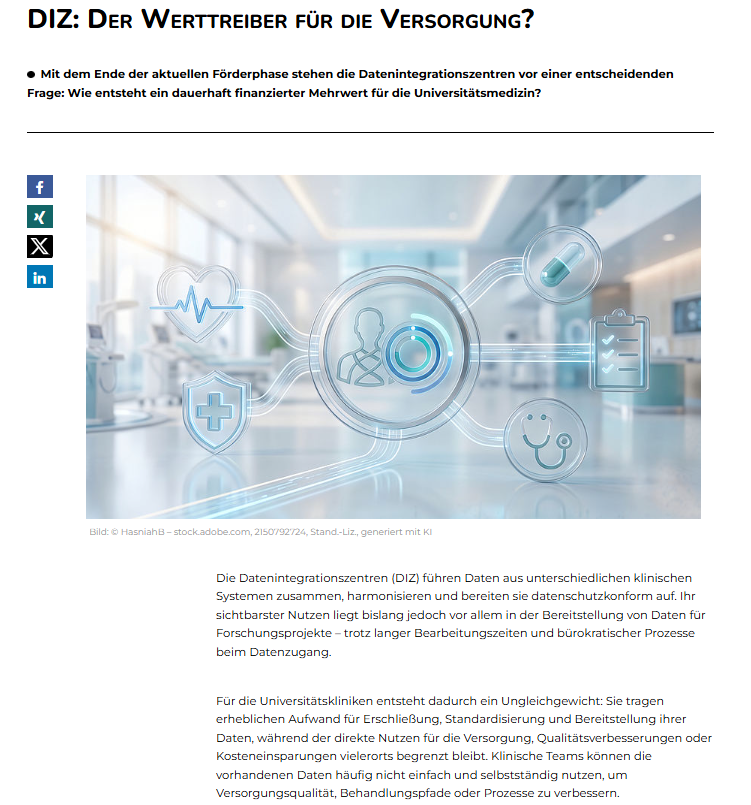
In a recent article for E-HEALTH-COM, Armin Scheuer examines how hospital data infrastructure can create measurable value beyond research. Although his article focuses on Germany’s university hospitals, the central question applies to any hospital everywhere: how can they turn data stored in their data warehouse or other systems into continuous improvements in care? Click here to access the full article in German.
Bringing data closer to care
The challenge is no longer simply whether hospitals have data; because “they do have more than enough”, according to Armin Scheuer. The real question is, whether the people responsible for patient care and hospital performance can use it effectively.
Access often depends on specialist IT, business intelligence or data science teams. Clinicians and operational leaders submit requests and wait for analyses, making it difficult to investigate emerging questions or act quickly on new insights.
Giving authorised professionals more direct access could help close this gap. Self-service tools can support the exploration of patient groups, care pathways and operational trends without requiring advanced technical skills. Synthetic data can provide a safer environment for initial analysis and collaboration, while AI can help users formulate questions and understand results.
These technologies do not replace professional judgement. Their use must remain supported by effective governance, privacy safeguards and validation against original data.
Online Masterclass: Turning DIZ Data into Lasting Value for Care
On 30 September 2026, from 16:00 to 17:00, experts from University of Chicago Medicine, MDClone and University Medicine Göttingen will share how clinical data can support measurable improvements in care.
Register below to join the Online Masterclass.
Making continuous improvement possible
The wider opportunity is to make data part of how hospitals routinely learn. Instead of using it primarily for individual studies or reports, teams can examine patient journeys, identify variations in care and measure whether interventions are producing better outcomes.
This approach can strengthen care quality while supporting more efficient hospital operations. Even modest improvements in patient flow, length of stay or treatment processes can create meaningful benefits for patients, professionals and health systems.
The situation in Germany
Germany’s university hospitals have established Data Integration Centres (DIZ) – Data Warehouses, which bring together clinical data through specialised integration. They consolidate and harmonise information from different systems under strict data protection requirements. Their most visible contribution has so far been to research.
As the current funding phase approaches its end, attention is shifting towards their long-term role. The question now is whether these data resources can move beyond research and become part of everyday clinical and operational improvement. Their value will ultimately be measured not by the volume of data they hold, but by the difference that data makes to care.