Chronic Care Performs Better with Digital Continuity
- Nataliya Bogdanova
- February 23, 2026
- TECHTALK
- Data2Value, Data2ValueExecutiveDialogue
- 0 Comments
Chronic diseases such as Multiple Sclerosis (MS) expose a structural limitation of visit-based healthcare systems. While diagnostics and treatment decisions are delivered at a high clinical standard, relevant risks emerge between appointments — affecting adherence, early symptom recognition, and long-term stability. The issue has now been addressed in German publication E-Health-Com.
The study “Building digital patient pathways for the management and treatment of multiple sclerosis” demonstrates that digital care pathways can structure complex therapies and better guide patients through everyday disease management. The White Paper on Multiple Sclerosis further highlights that fatigue, cognitive slowing, and depressive symptoms significantly impair therapy adherence — often precisely during periods without physician contact.
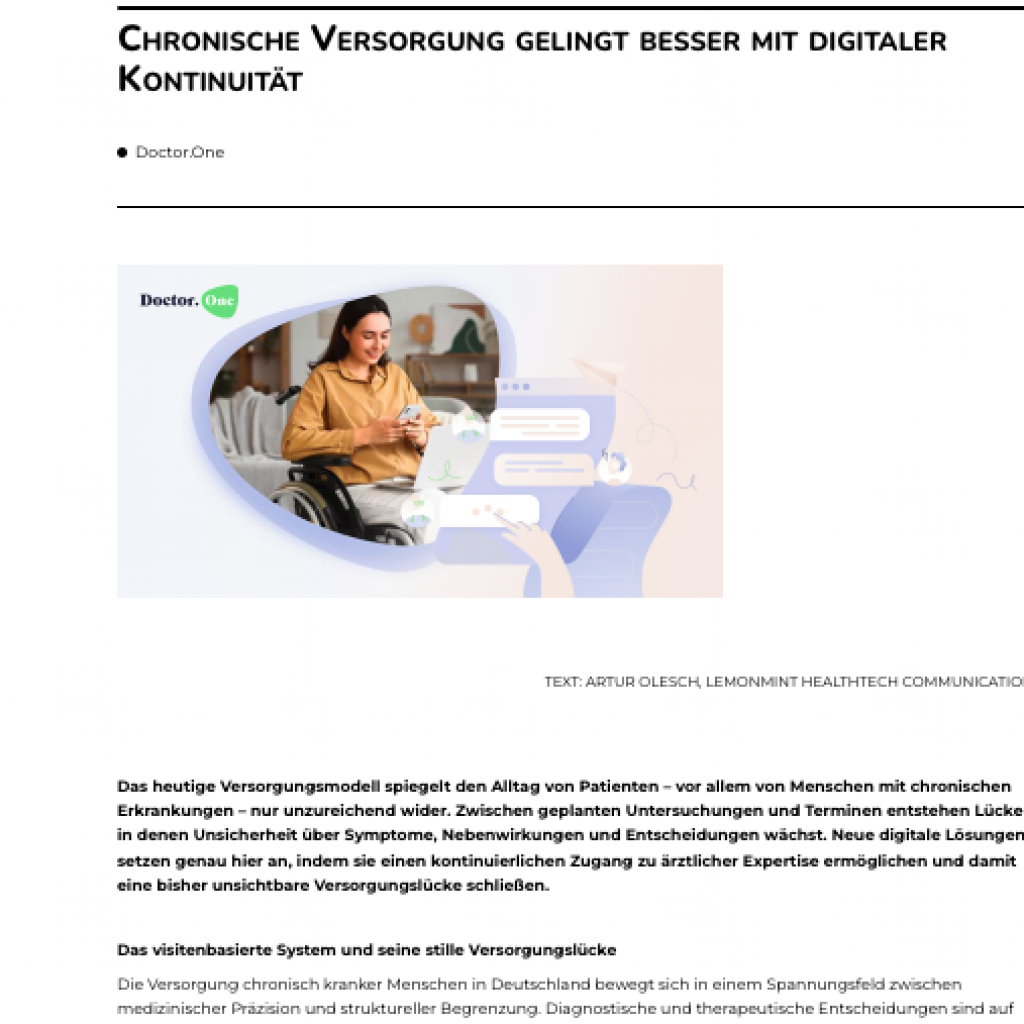
E-Health-Com is one of Germany’s most influential B2B publications for the digital transformation of healthcare. A recent report by Artur Olesch discussed how digitally enabled continuity of care can close structural gaps in chronic disease management, highlighting scientific evidence and showcasing platforms such as Doctor.One as scalable infrastructure for hybrid care models.
Randomized evidence supports this approach. The RCT “Effectiveness of a digital lifestyle management intervention (levidex)” reported clinically meaningful improvements in quality of life, reduced disease-related absenteeism, and increased activity levels.
For clinicians and healthcare executives, these findings suggest that structured digital continuity is not merely a communication enhancement, but a clinically relevant intervention.
System Pressure Increases the Need for Scalable Solutions
Healthcare systems are facing mounting capacity constraints. A projection by BARMER and Bertelsmann estimates that by 2040, general practitioners in Germany may only be able to cover approximately 87% of healthcare demand. At the same time, OECD data (Health at a Glance 2025) show that Germany already records high physician visit rates per capita without proportionally better outcomes.
For CIOs and clinical leaders, this indicates that increasing visit volume alone will not solve structural challenges. More efficient allocation of medical expertise – supported by digital infrastructure – will be critical.
Doctor.One Enables Structured Digital Continuity
Doctor.One addresses this gap with a continuous digital care platform designed for integration into routine clinical workflows. The solution enables structured, documented micro-interactions between physicians and patients, extending medical oversight into the intervals between visits.
By supporting early detection of clinically relevant signals, stabilizing therapy adherence, and reducing uncertainty, the platform strengthens chronic disease management without increasing appointment frequency.
With nearly half a million documented micro-interactions across neurology, oncology, endocrinology, and obesity care, Doctor.One demonstrates operational scalability and cross-specialty applicability. The platform is built to align with existing clinical processes, minimizing administrative burden while enhancing continuity of care.
A Strategic Infrastructure Component for Modern Care Delivery
For CIOs, Chief Medical Directors, and clinical teams, digital continuity represents a strategic infrastructure layer within hybrid care models:
- Improving therapy adherence
- Enabling earlier intervention
- Optimizing physician capacity
- Supporting value-based care frameworks
As chronic disease prevalence rises and workforce constraints intensify, structured digital continuity may become a core component of sustainable, high-performance healthcare systems.
Doctor.One was founded in 2021 as a medtech start-up in Warsaw and has become one of the most successful digital care initiatives in Poland. Following collaborations including with the University Clinical Center in Gdańsk, as well as programmes with international pharmaceutical companies such as Novartis, Novo Nordisk, Merck and AstraZeneca, the company is expanding into additional European markets, including Germany.