“Digital Maturity Tour: Diabetes Report Released”
- lealedwon
- January 16, 2026
- DIGITAL MATURITY INITIATIVE
- 0 Comments
More than 830 million people worldwide live with diabetes. The numbers are rising fastest where health systems are least prepared – and where data, if available at all, is rarely turned into action. Against this backdrop, Scotland offers a compelling counterexample: a health system that treats digital maturity not as a technology upgrade, but as a foundation for better care. That insight emerged clearly during last year’s Digital Maturity Tour event in Glasgow, hosted by the Digital Health & Care Innovation Centre (DHI), the International Diabetes Federation (IDF), and Lemonmint. The report is now available.
Diabetes as a stress test for health systems
Diabetes exposes the strengths and weaknesses of modern healthcare. It demands long-term follow-up, coordination across care settings, and continuous learning from real-world data. Yet in many countries, health data remains fragmented, governance is slow, and promising innovations struggle to scale beyond pilots.
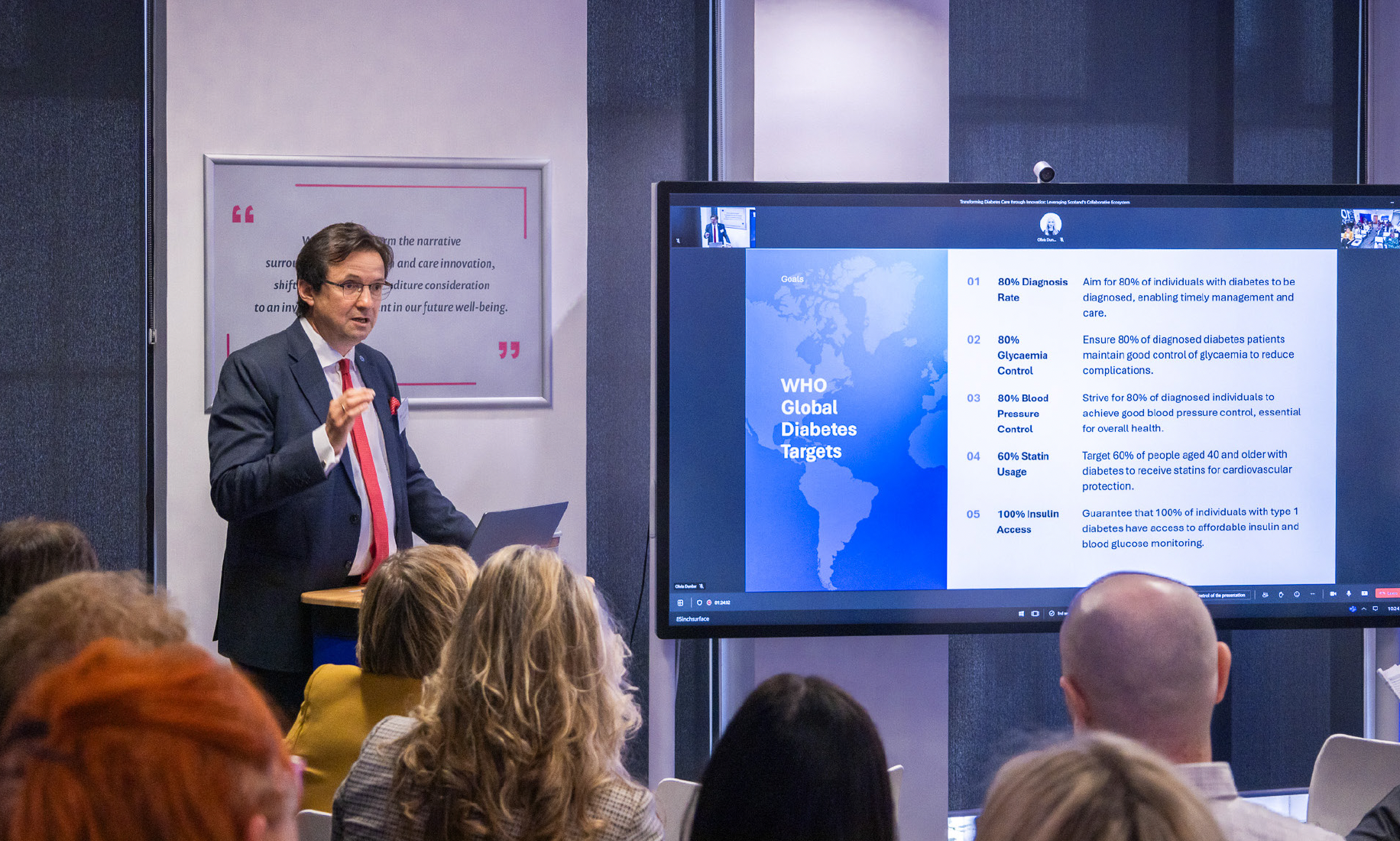
In his keynote, IDF President Professor Peter Schwarz made the challenge explicit: the tools already exist. AI, digital platforms, and advanced analytics are available today. What’s missing is the ability to turn them into trusted, usable systems, particularly for underserved populations. Scotland’s experience suggests that the answer lies less in breakthrough technology and more in how systems are designed and governed.
What Scotland is doing differently
Scotland’s diabetes ecosystem is built around national coherence. Platforms such as SCI-Diabetes link data across primary and secondary care and are used by around 3,000 clinicians each month. A strong research infrastructure supports more than 160 clinical trials, while policy, practice, and innovation are deliberately aligned rather than developed in isolation.
What Scotland is doing aligns closely with the vision and mission of the IDF to improve the quality of care for people living with diabetes.
Prof. Peter Schwarz, President, IDF
During the Digital Maturity Panel, Armin Scheuer, CEO of Lemonmint, described digital maturity as a combination of policy, culture, and measurable value – not software alone. That people-first perspective was echoed throughout the discussion. International examples, from Saudi Arabia’s virtual hospitals to Germany’s large-scale digital investments, reinforced a shared lesson: technology only delivers impact when governance, workforce skills, and interoperability evolve alongside it.
Scotland’s Accelerated National Innovation Adoption (ANIA) pathway illustrates this principle in practice. Designed to move innovations from pilot to population level, it addresses one of healthcare’s most persistent bottlenecks. Initiatives such as national virtual onboarding for closed-loop insulin systems and the My Diabetes My Way platform show what becomes possible when scale is considered from the outset.
What changes when data becomes usable
The effects are tangible. Clinicians gain faster access to relevant information, supporting better decisions at the point of care. Patients are given more control through digital tools that are embedded in routine workflows rather than added as optional extras. Health systems, in turn, learn continuously from their own data. Importantly, patient perspectives were not treated as an afterthought. Lived experience featured prominently in the final panel, underlining that digital maturity must translate into equitable access, personalization, and trust – not just efficiency gains.
The discussions closed with a clear direction: simplify governance, invest in digital literacy, and deepen international collaboration. IDF and Scottish partners are already exploring joint work on global AI guidelines and standards, turning local experience into shared global assets.
The Digital Health & Care Innovation Centre (DHI) is a national resource and key enabler and catalyst for change, occupying a unique and visible position at the heart of the innovation ecosystem for digital health and social care in Scotland.